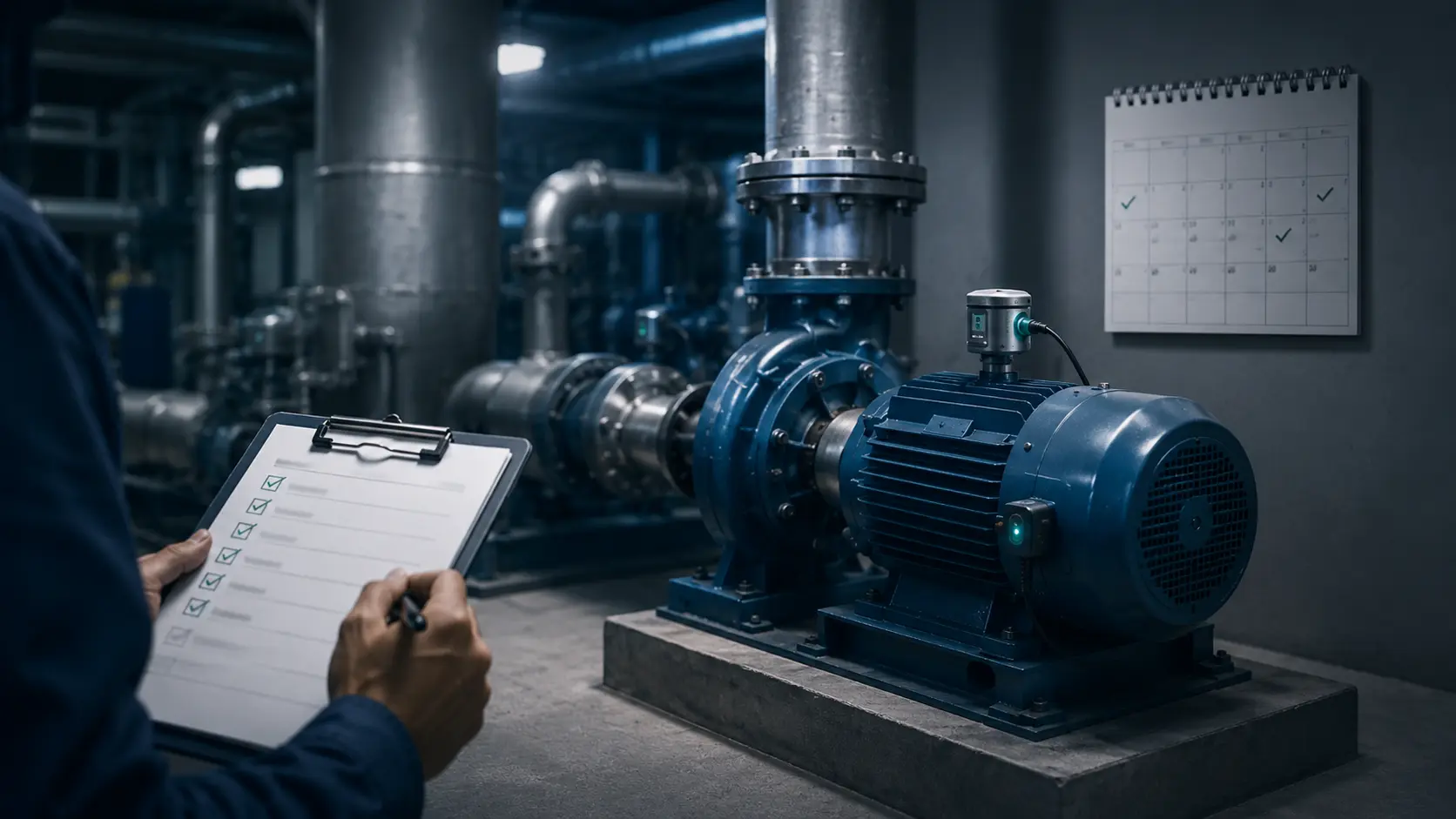
THE VISIBILITY GAP
Quarterly Inspections vs. Continuous Monitoring
The quarterly inspection captures the condition on the exact day it is visited. Continuous condition monitoring captures what happens between those visits — which is exactly where the failure develops.
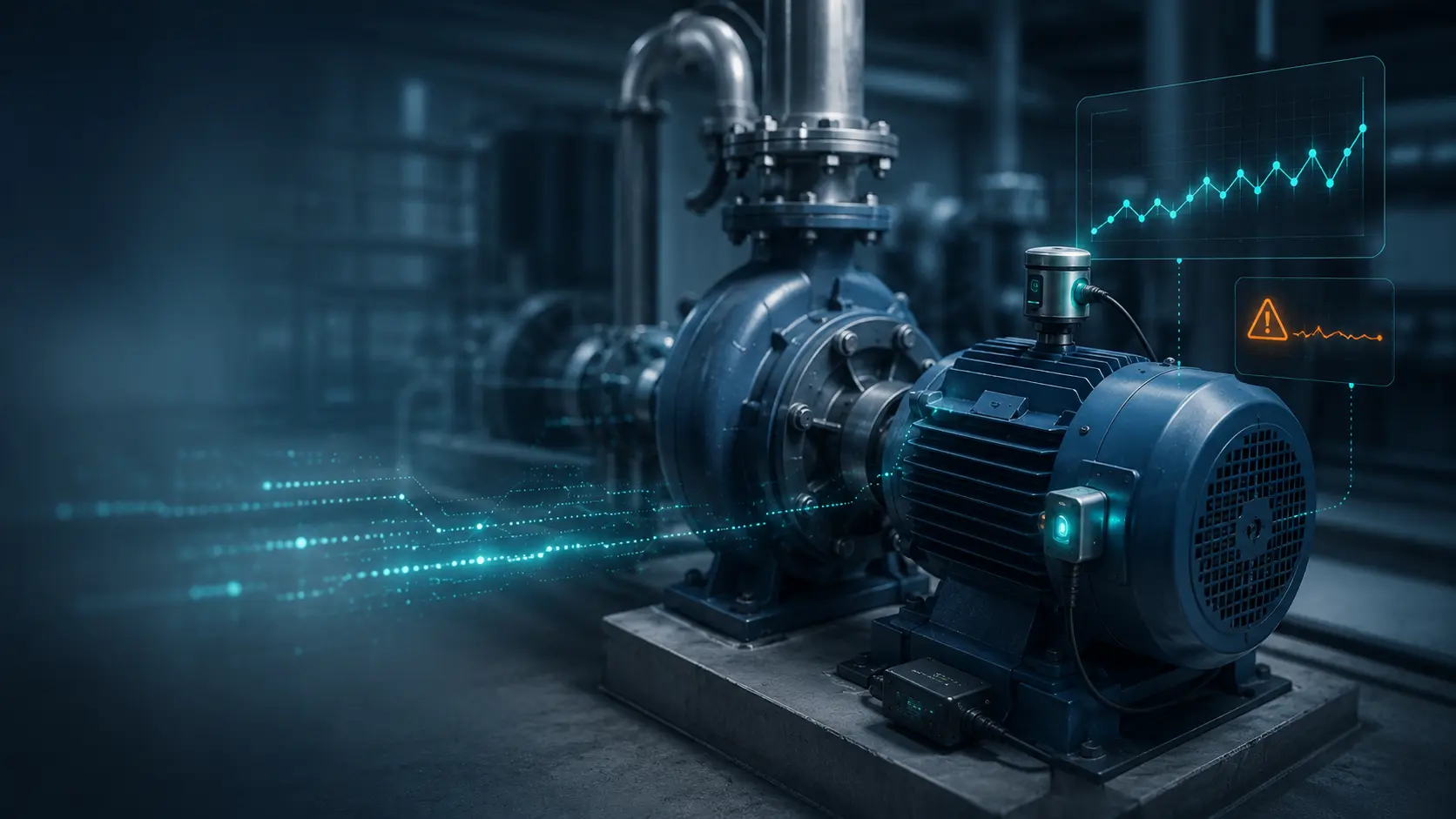
Monitoring works by reading the signals that precede equipment failure. It does not wait for the failure itself; it detects the developing conditions that make failure inevitable if nothing changes.
What Gets Monitored and What Each Signal Means
Each sensor type reads a specific signal on a specific asset category.
What it measures
Motor current draw vs baseline
Assets
HVAC, chillers, pumps, compressors
Signal Indicates: Rising current = increasing mechanical stress, component wear
What it measures
Surface or fluid temperature
Assets
HVAC, electrical panels, cooling towers
Signal Indicates: Elevated temperature = overheating, refrigerant loss, failing component
What it measures
Frequency and amplitude
Assets
HVAC, chillers, pumps, motors
Signal Indicates: Abnormal vibration = bearing wear, imbalance, misalignment
What it measures
Operating hours per cycle
Assets
All mechanical equipment
Signal Indicates: Extended runtime to maintain setpoint = declining efficiency, developing fault
What it measures
Presence of water
Assets
Mechanical rooms, under HVAC, rooftop
Signal Indicates: Water where it shouldn't be — before it becomes visible damage
What it measures
Consumption per circuit or zone
Assets
Electrical panels, building total
Signal Indicates: Anomalous consumption = equipment fault, unauthorized load, efficiency loss
Each reading is measured against a baseline established for that specific asset in its specific operating environment — not against a generic manufacturer specification. An HVAC unit in a high-humidity coastal market has a different normal current draw than the same model in an arid inland location. The signal that matters is the deviation from that unit's own history, not from a standard that doesn't account for its operating conditions.
From Signal to Work Order — Without Anyone in Between
The value of a sensor is not the data it produces. It's the action that data generates. A sensor that sends a reading to a dashboard that someone checks periodically has not changed the operational outcome — it's added a monitoring task to someone's day.
Sweven's IoT monitoring is integrated directly into the AI Dispatch Engine. When a sensor reading crosses a configured threshold or sustains an anomaly pattern for a defined duration, the engine evaluates it and acts — without requiring an FM to see the alert, open a separate system, and manually create a response.
The flow from signal to resolution:
1. Detection: A current transducer on a rooftop HVAC unit detects a 14% increase in motor current draw sustained over 72 hours.
2. AI Evaluation: The engine evaluates the signal against the asset's baseline, the asset's compliance criticality, and the configured threshold for that sensor type. It classifies the finding as a priority diagnostic PM — not an emergency, but not deferrable.
3. Automated Creation: It creates a work order pre-populated with the asset details, the sensor data, and the recommended scope.
4. Smart Dispatch: It routes to the HVAC vendor with the highest performance score and current EPA 608 certification for that location.
5. Vendor Action & FM Visibility: The vendor receives the dispatch. The FM receives a notification: a work order was created and dispatched based on a condition alert, review and confirm.
The Outcome: The FM did not have to find the alert, create the work order, find the vendor, or verify their certification. The signal moved directly to a scheduled diagnostic visit before the unit failed — at planned labor rates, on a day and time that works for the building. That is the true operational outcome IoT monitoring is designed to produce: fewer emergency repairs, not just more data.
Where Condition Monitoring Delivers the Highest ROI
Not every asset justifies sensor investment. The cases with the strongest return are the assets where the consequence of undetected failure — in emergency repair cost, downtime, compliance exposure, or secondary damage — significantly exceeds the cost of the sensor and the PM it triggers.
Commercial HVAC
Aging or critical zone equipment: A rooftop unit serving an office floor running 11% outside its normal current draw baseline will fail. The question is whether it fails during a scheduled diagnostic visit (technician already on-site, parts sourced in advance, planned labor rate) or during peak occupancy on a Monday morning (emergency dispatch, expedited parts, premium labor, tenant complaints, potential lease implications).
Research indicates that operations with predictive maintenance programs can reduce maintenance costs by 30 to 45 percent compared to reactive operations. The HVAC unit is the primary driver of that gap in most commercial portfolios.
Commercial Refrigeration
F&B and hospitality: A walk-in cooler running 4°F above setpoint is a food safety event before it is an equipment failure. The temperature data that prevents the health department finding exists in the sensor. The consequence of not having it — food loss, health citation, temporary closure — far exceeds the sensor investment and the work order it generates.
Continuous monitoring converts a compliance obligation from a periodic inspection check to a real-time operational state.
Electrical Distribution Equipment
Panels and switchgear: Permanent thermal sensors on critical switchgear and panel connections provide between-inspection visibility — detecting the hot spot that develops in month four of a twelve-month inspection cycle, before it reaches the temperature at which arc fault or fire becomes probable.
Building electrical system failures account for a disproportionate share of commercial building insurance claims — and the majority are preceded by detectable thermal anomalies that appear days or weeks before the failure event.
Emergency Generators & Water Systems
Load test compliance: Continuous runtime monitoring confirms that required monthly generator tests are being executed as scheduled. A generator that has not been exercised under load produces a load test record that the documentation system cannot distinguish from one that has — unless the sensor confirms the runtime.
Water and leak detection: Water damage in commercial buildings is one of the highest-cost categories of property insurance claims. A water sensor that detects moisture in a mechanical room within minutes of a leak event prevents the water migration, ceiling damage, electrical exposure, and remediation timeline that follows an undetected leak. The sensor cost is low. The potential loss prevented is not.
What Changes in the Operation
The shift that IoT condition monitoring produces in a commercial portfolio is not visible in any individual work order. It is visible in the ratio of planned to reactive maintenance over time — and in the emergency calls that do not happen.
Before condition monitoring: the quarterly PM visit captures what exists on the day of the visit. The 89 days between visits are operationally invisible. Emergency calls arrive without warning. The root cause of each failure is reconstructed after the fact, without the data that would have shown the developing condition.
After condition monitoring: the 89 days between PM visits are visible — not comprehensively across every operating parameter, but at the thresholds that precede failure in the asset types that matter most. The PM visit arrives with the sensor data pre-loaded in the work order, giving the technician context the quarterly visit alone never provided. Emergency calls decrease as planned interventions replace reactive responses.
Smart building technology properly deployed can reduce building energy use 10 to 30 percent and maintenance response time significantly. The precision in that sentence is "properly deployed" — which means sensors on the right assets, thresholds calibrated to operational baselines, and signals connected to action rather than to dashboards that accumulate data nobody has time to review.
The Signal Layer of a Complete Maintenance Operation
IoT asset monitoring is the condition intelligence layer. It doesn't operate as a standalone monitoring platform — it operates as the input layer to the AI Dispatch Engine, converting asset condition signals into maintenance actions without requiring human interpretation at each step. The sensor detects. The engine acts. The vendor resolves. The payment releases on verified completion. The compliance record exists because the work order was closed correctly. That sequence is only possible because each layer connects to the next.
AI Dispatch Engine
How the engine acts on sensor signals
Vendor Marketplace
The verified network that resolves what sensors find
Compliance & Reporting
The record built from every sensor-triggered work order
TAKE ACTION
Find Out Which Assets in Your Portfolio Need Monitoring
Not every asset in every building needs a sensor. The assets that justify monitoring are the ones where the consequence of undetected failure — financially, operationally, or from a compliance standpoint — exceeds the cost of knowing.